How exchange rates are set and why they change: a full reference
Exchange-rate regimes (free and managed float, fixed/peg), the drivers that move a rate (supply and demand, interest rates, inflation, the trade balance, capital flows), nominal vs real rates, and purchasing power parity (the Big Mac Index). With Uzbekistan's case: the 5 September 2017 liberalization (4,210 → 8,100 som/dollar) and the som's rate today. Based on the IMF and the Central Bank of Uzbekistan.
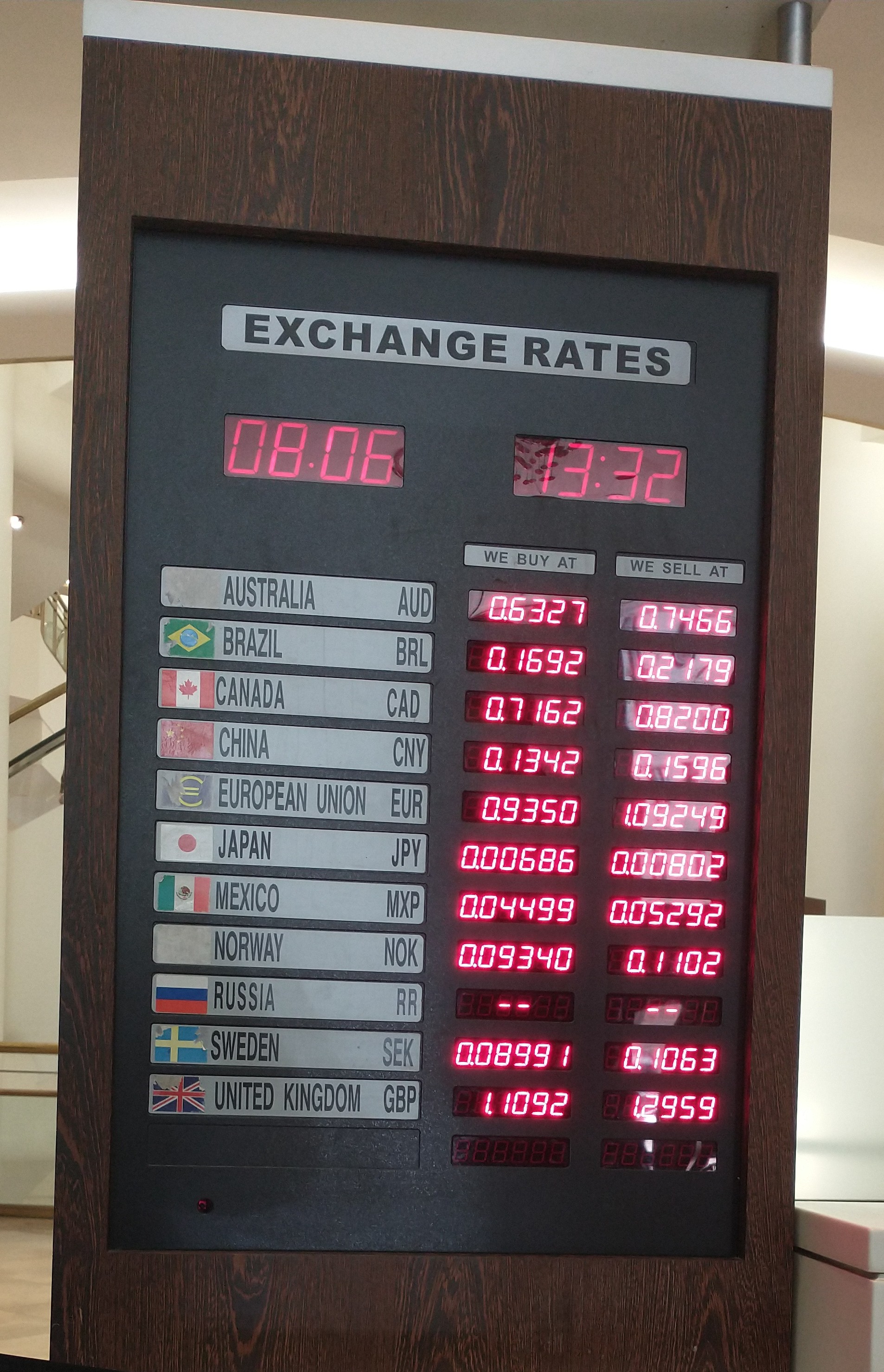
An exchange rate is the price of one country's money in terms of another's (for example, how many som equal one dollar). It matters directly for remittances, import prices, savings, and trade. Below, how a rate is set and why it changes is explained with facts, based on the IMF, the Central Bank of Uzbekistan, and other sources.
Exchange-rate regimes
How a rate is determined depends on the “regime.” The main types: a free (clean) float — the rate is set purely by market supply and demand, with no government intervention; a managed (dirty) float — the market mostly sets it, but the central bank may intervene to smooth sharp swings; a fixed/pegged regime — the currency is locked to another currency or a basket; a currency board — a peg reinforced by strict legal rules; and dollarization — a country abandons its own money and adopts another's (for example the dollar). Uzbekistan today operates a managed float, and its central bank affirms its commitment to a floating rate.
What moves a floating rate
Under a floating regime a rate changes with these standard drivers: supply of and demand for the currency (tied to exports and imports); interest-rate differentials (a higher real rate attracts foreign capital and strengthens the currency); inflation differentials (lower inflation strengthens it); the trade balance and current account (a surplus raises demand for the currency); capital flows (inflows of foreign investment strengthen it, outflows weaken it); market expectations and speculation; and central-bank intervention. Intervention often has only a short-term effect — over the long run the rate is set by fundamentals (inflation, interest rates, growth).

Nominal vs real rate; appreciation and depreciation
The nominal rate is the market quote (how many som per dollar). The real rate adjusts the nominal rate for the difference in price levels (inflation) between two countries and measures international competitiveness. Note the terms: under a floating regime a currency can strengthen (appreciation) or weaken (depreciation) through the market; under a fixed regime, when the government officially raises the rate it is a revaluation, and when it lowers it, a devaluation.
Purchasing power parity and the Big Mac Index
Under the theory of purchasing power parity (PPP), in the long run a rate tends toward the level that equalizes the price of an identical basket of goods across two countries. A popular illustration is the Big Mac Index, published by The Economist since 1986: it compares the price of the same Big Mac across countries against the US price to show whether a currency is “undervalued” or “overvalued.” It is a simplified illustration, not a precise measure.
Uzbekistan's case: the som and the 2017 liberalization
Uzbekistan's national currency is the som (international code UZS). It is issued by the Central Bank of the Republic of Uzbekistan, which manages the rate. On 5 September 2017 Uzbekistan liberalized its currency market: the official rate was lowered from about 4,210 som per dollar to roughly 8,100, the som was moved to a floating regime, and restrictions on buying foreign currency were removed. This unified the previous dual (official and “black-market”) rates; the new official rate was set even slightly weaker than the black-market rate to encourage people to sell dollars to official banks.
Since the liberalization the som has moved gradually under market conditions. According to the central bank, as of September 2026 one dollar is around 11,800 som (the daily rate is published at cbu.uz). A floating rate lets the som absorb external shocks (world prices, remittance flows) more smoothly.
How remittances and exports affect the som
Remittances sent by citizens abroad (especially in Russia and South Korea) increase the inflow of foreign currency and support the som. Likewise, when the world price of export goods — gold, natural gas, cotton — rises, foreign-currency earnings grow and pressure on the som eases; when prices fall, the reverse. So to follow the som's rate, watch inflation, interest rates, remittances, and commodity prices.
