Mustafa Chokay and the Turkestani political emigration (1917–1941)
The life and émigré history of Mustafa Chokay (1890–1941), a leader of the Turkestan (Kokand) Autonomy: the autonomy proclaimed in November 1917, its suppression in February 1918, his route Baku–Tbilisi–Istanbul–Paris into France, the journal “Yash Turkestan” printed in Berlin 1929–1939 (117 issues), his stance in the Second World War, and his death in 1941. The Promethean movement and other Turkestani émigrés. Verified facts only; disputed details are flagged.
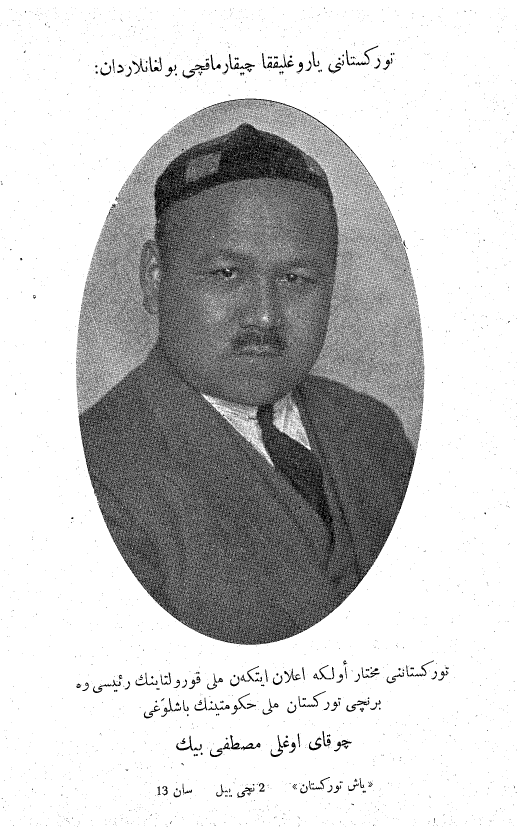
Mustafa Chokay (Mustafa Shokay; 25 December 1890 – 27 December 1941) was a leader of the Turkestan (Kokand) Autonomy, a jurist and publicist, and the most prominent Turkestani political émigré of the 20th century. His life and emigration are set out below with verified facts only, based on muxtoriyat.uz, shokay.kz, e-history.kz, and academic studies (including work on the journal “Yash Turkestan”). Disputed details, or those cited differently across sources, are flagged in the text.
Who Mustafa Chokay was
He was born on 25 December 1890 in the Syr-Darya region of Russian Turkestan (near present-day Kyzylorda in Kazakhstan) into a prominent family; he was Kazakh by nationality. He finished the Tashkent gymnasium (around 1910, with a gold medal) and the law faculty of the Imperial (Saint Petersburg) University. He was a jurist and journalist-politician by profession.
The Turkestan (Kokand) Autonomy
On 27 November 1917, at the extraordinary All-Turkestan Muslim Congress in Kokand, Turkestan was proclaimed an autonomous territory within a federal Russia. Chokay was elected first foreign affairs minister and then head of government (prime minister) — the first prime minister had been Mukhamedzhan Tynyshpaev. In February 1918 the Red Army forces of the Tashkent Soviet (commanded by Fyodor Kolesov) attacked Kokand, shelled the city, and the autonomy was dissolved (formally around 22 February). The number of victims is cited differently across sources (given as over ten thousand); the exact figure is not reliably established.

The road into emigration
After the autonomy was crushed, Chokay went south to Baku, then to Tbilisi (Georgia, 1919–1921). When Georgia was sovietized, he travelled via Istanbul to Paris in the summer of 1921. From about 1923 he lived in Nogent-sur-Marne, a suburb of Paris, which remained his base until 1941. He thus became the leading Turkestani political émigré of the interwar period.
The journal “Yash Turkestan”
In emigration Chokay first ran a journal titled “New Turkestan” (Yeni Türkistan) and then his best-known publication, “Yash Turkestan” (Young Turkestan). It was printed in Berlin from 1929 to 1939, with 117 issues in all (some combined); according to some sources the material was prepared in Paris and printed in Berlin. In the Chagatai-Turkic language and Arabic script, it advanced the idea of the national independence and cultural unity of the Turkestani peoples and criticized Soviet rule.
The Second World War and his death
When Germany invaded the USSR in 1941, Chokay was taken by the Germans to inspect camps holding Central Asian Red Army prisoners, and he was asked to take part in forming a “Turkestan Legion” from them. Reputable sources record that, dismayed by the treatment of the prisoners, he refused to lead or collaborate in the Legion. He died in Berlin on 27 December 1941; the recorded cause was blood poisoning amid a typhus epidemic contracted in the camps. A poisoning theory has circulated but is not established by any reputable source; the Turkestan Legion was in fact formed later (1941–42) without him.
The Promethean movement and other émigrés
Chokay was associated with the Promethean movement, an interwar coalition of anti-Soviet émigré national movements. The “Prometheus” organization was founded in Paris in 1926 and later centred in Warsaw, uniting Ukrainian, Georgian, Azerbaijani, North Caucasian, and Turkestani émigrés. Chokay worked alongside Caucasus figures such as Mehmed Emin Rasulzade; other Turkestani émigrés included Zeki Velidi Togan and Osman Khoja, and after the war Baymirza Hayit became the leading émigré historian of Turkestan.
Context and legacy
Chokay's emigration was part of a wider picture: the Basmachi resistance was crushed by the early 1930s, driving survivors into Afghanistan and Turkey, while the Jadid intelligentsia inside the USSR was largely destroyed in the purges of the late 1930s. Émigrés such as Chokay and Togan carried the cause on in Turkey and Western Europe. Today his legacy is widely honoured in Kazakhstan — with streets in Kyzylorda and Almaty (2006), museum holdings, and multi-volume editions of his works; in France a monument (2001) and a memorial plaque (2008) stand in Nogent-sur-Marne.
