Uzbekistan and Serbia Establish a Strategic Partnership: 20 Documents Signed in Belgrade
A joint declaration was signed at the close of Mirziyoyev's first visit to Belgrade. The two sides agreed to open negotiations on a free trade agreement, launch direct Belgrade–Tashkent flights and support the Middle Corridor.
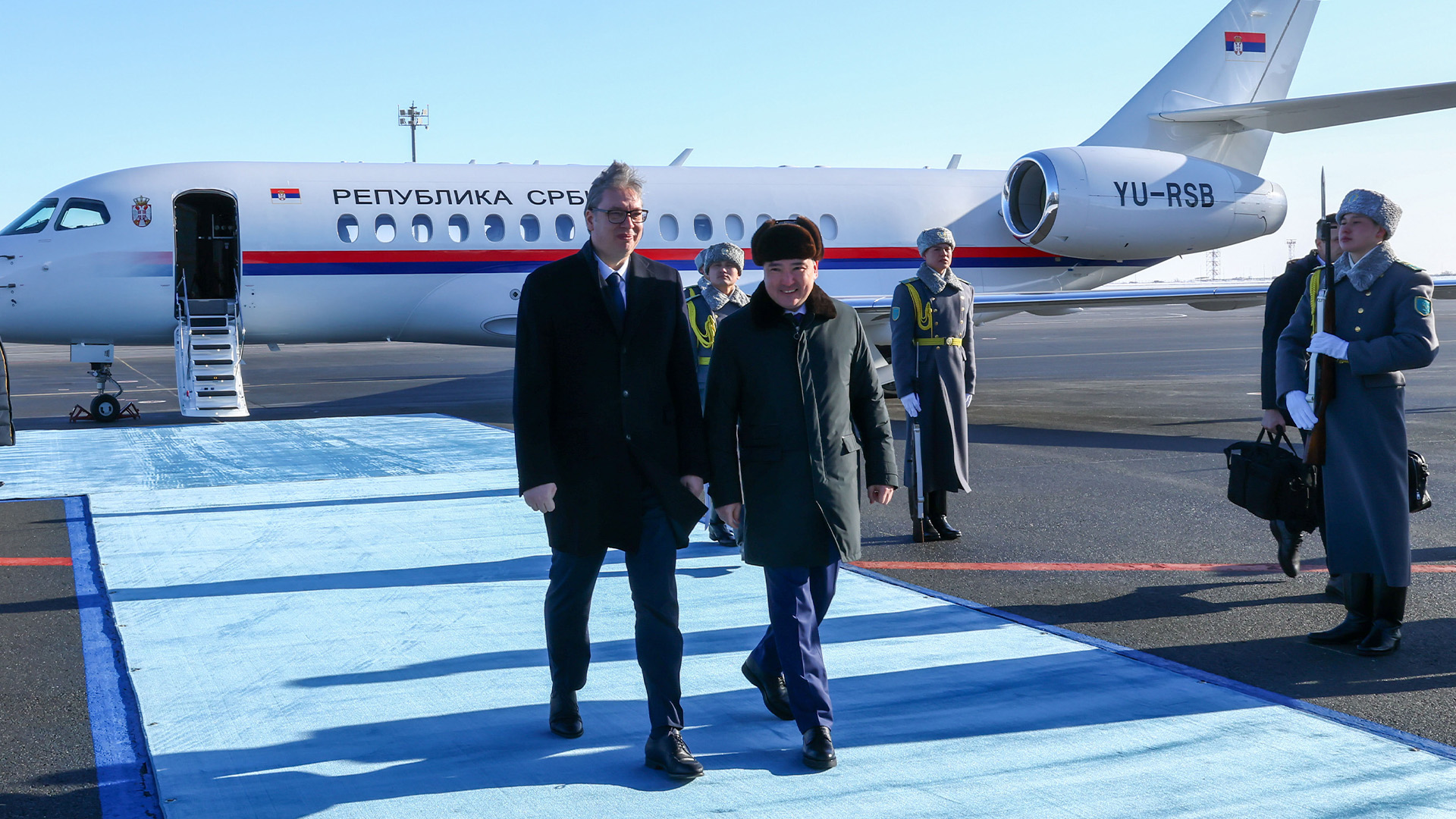
On Sept. 8, 2026, Uzbek President Shavkat Mirziyoyev and Serbian President Aleksandar Vučić held talks in Belgrade. At the close of the meeting, a Joint Declaration was signed establishing strategic partnership relations between the two countries.
It was the Uzbek president's first official visit to Serbia. Tashkent had announced the visit on Sept. 5.
Today we have taken a historic decision to establish a strategic partnership between Serbia and Uzbekistan. This shows once again that this visit is historic and that we have taken a historic decision.
— Shavkat Mirziyoyev, President of Uzbekistan (from Euronews translation, 08.09.2026)
What was signed
The two sides signed 20 bilateral documents. They cover trade, transport, energy, digitalization and labor migration. According to Gazeta.uz, the documents span 18 areas.
- Agriculture, water management and sustainable rural development
- Tourism and cultural exchange
- Renewable energy and green technologies
- Railway infrastructure and the Middle Corridor
- Negotiations on a free trade agreement
- Labor migration and road transport
- Pharmaceuticals and biotechnology
- Digitalization and e-government
- Environmental protection
A separate document approved an action plan on industrial cooperation for 2026–2028. Partnership relations were established between the Samarkand region and Serbia's autonomous province of Vojvodina.
By the numbers
- Documents signed: 20
- Areas covered: 18
- Trade volume last year: $41.9 million (a record)
- 2024 trade volume: $32.9 million
- Annual growth: +27%
- Serbian agricultural exports (2026, 7 months): +54.1%
- Industrial cooperation plan: 2026–2028
Trade turnover between the two countries reached $41.9 million last year — a record figure. In 2024 the figure was $32.9 million, meaning growth of 27 percent. Serbia's exports of agricultural and food products to Uzbekistan rose 54.1 percent in the first seven months of 2026.
In absolute terms, however, trade volumes remain small: Serbia's share of Uzbekistan's total foreign trade turnover is well below one percent.
Free trade and air service
Serbian President Aleksandar Vučić said the two sides would move toward concluding a free trade agreement and wanted to establish direct air service between Belgrade and Tashkent. There are currently no direct flights between the two capitals; travelers fly via Istanbul, Dubai or European cities.
Uzbekistan currently holds observer status in the Eurasian Economic Union and is pursuing accession to the World Trade Organization. A free trade agreement with Serbia is one of Tashkent's efforts to broaden its trade network in the European direction.
The Middle Corridor
The two sides signed documents on supporting the Middle Corridor — the trans-Caspian trade route linking Central Asia with Europe through the Caspian Sea, Azerbaijan, Georgia and Turkey.
The Middle Corridor has become a priority for Central Asian states in recent years: the traditional routes through Russian territory have been affected by the sanctions regime and logistical restrictions. Because Uzbekistan is landlocked, the question of alternative routes carries systemic importance for it.
Labor migration
The signed documents include an agreement on labor migration. Serbia has been attracting foreign labor for infrastructure and construction projects in recent years.
This track is of particular importance to Uzbekistan: against the backdrop of tightening migration policy in Russia, Tashkent is seeking to diversify its labor migration destinations. In early September, the Migration Agency reported that 96,415 citizens had returned from Russia within ten days.
Symbolic events
Aleksandar Vučić presented Shavkat Mirziyoyev with Serbia's highest state award, the Order of the Republic of Serbia on a Grand Collar. The two leaders took part in a ceremony naming a street in Belgrade after Tashkent.
Context
How the visit was organized
The Uzbek president's press service announced the visit on Sept. 5. An official welcoming ceremony was held in Belgrade on Sept. 8, followed by talks in narrow and expanded formats. At the close of the talks, a document exchange ceremony and a joint statement to the press were held.
A business forum with entrepreneurs from both countries was also held as part of the visit. It discussed projects in agriculture, the food industry, pharmaceuticals and construction materials manufacturing.
The history of relations between the two countries
Diplomatic relations between Uzbekistan and Serbia were established in the second half of the 1990s. For a long time, contacts were conducted on a limited scale, mainly within the framework of international organizations; embassies in the two capitals opened relatively recently.
Ties have intensified in recent years. Trade turnover reached a record $41.9 million in 2025. Serbia exports mainly food products, pharmaceuticals and machinery to Uzbekistan; Uzbekistan supplies textiles and agricultural products.
Vojvodina and Samarkand
The establishment of partnership relations between the Samarkand region and Serbia's autonomous province of Vojvodina was one of the visit's practical outcomes. Vojvodina is Serbia's principal agricultural region; the Samarkand region is one of Uzbekistan's major areas for growing and processing fruit and vegetables.
Interregional partnerships generally involve cooperation on agricultural technology, seed production, irrigation systems and processing enterprises. No list of specific projects has been announced.
The European direction
The strategic partnership with Serbia is part of Uzbekistan's diplomacy in the European direction. Since 2021, Tashkent has benefited from the European Union's GSP+ preferential trade regime — a regime that gives most Uzbek products duty-free access to the EU market.
Serbia is a candidate country for EU membership but has not yet joined the union. For that reason, a free trade agreement between the two countries may be concluded separately from European Union rules.
Serbia is a candidate country for EU membership while also maintaining economic ties with Russia and China. Vučić made an official visit to Kazakhstan in February 2026 — that is, Belgrade's activity in the Central Asian direction has grown over the course of this year.
For Uzbekistan, the visit was part of a dense diplomatic schedule in September. Mirziyoyev attended the SCO summit in Bishkek on Sept. 1, and from Sept. 13 to 16 he made a state visit to South Korea and took part in the first Korea–Central Asia summit in Seoul.
The joint declaration establishes the status of a strategic partnership, but it is not an international treaty and does not require ratification. Negotiations on a free trade agreement are a separate process, and no timeline for them has been announced.