Sunni and Shia Islam: Their Differences, Historical Origins, and Schools
Islam's two main branches — Sunni and Shia — grew out of the question of who should lead the community after the Prophet Muhammad (peace be upon him). Here are the history of that split, the main theological and legal differences, the schools, the rough global distribution, and the situation in Uzbekistan and Central Asia — set out neutrally and respectfully.
Islam is a single faith united around one God, one Qur'an, and one Prophet (Muhammad, peace be upon him). Even so, Muslims have historically divided into two main branches — Sunni and Shia. What separates them is not the core of belief but, above all, the question of who was to lead the community after the Prophet's death and how religious authority passes on. This article explains the two traditions in an educational, neutral way, without favoring either (Source: Britannica — Islam; BBC — Sunni and Shia).
The origin of the split
When the Prophet Muhammad (peace be upon him) died in 632 CE, it is widely held that he left no explicitly designated and universally acknowledged successor. This raised the question among Muslims of who would now lead the community. The majority community, later called Sunni, chose the Prophet's close companion Abu Bakr as the first caliph on the basis of consultation (shura) and communal consent. Another group, later called Shia (shiatu Ali, "the party of Ali"), held that leadership should belong to Ali ibn Abi Talib, the Prophet's cousin and son-in-law (Source: Britannica — Shia; Wikipedia — Succession to Muhammad).
The dispute over the caliphate
From the Sunni point of view, the community itself should determine the Prophet's successor through mutual agreement; Sunnis therefore honor the first four caliphs — Abu Bakr, Umar, Uthman, and Ali — as the "Rightly Guided Caliphs." Shias regard Ali as the Prophet's rightful heir and consider it wrong that leadership first passed to others. Ali eventually became the fourth caliph, but his reign was marked by internal strife. Thus the initial disagreement was about political and social leadership rather than theology; doctrinal differences developed later (Source: BBC — Sunni and Shia; CBC — Sunni, Shia conflict rooted in dispute over successor).

The Battle of Karbala (680 CE)
The most important event in solidifying the split was the battle fought in 680 CE at Karbala, in present-day Iraq. There the Prophet's grandson, Ali's son Imam Husayn, and his small group stood against the army of the Umayyad caliphate and were killed. This tragedy took on deep religious and emotional meaning for Shias and cemented their distinct identity. Husayn's martyrdom is commemorated each year on the day of Ashura. Many historians regard Karbala as the turning point that turned the Sunni-Shia divide into separate religious traditions (Source: Britannica — Husayn ibn Ali; Wikipedia — Battle of Karbala).
Where authority lies: caliph or imam
The most important theological difference between the two traditions is the question of religious authority. In Sunnism there is no infallible leader divinely guided after the Prophet; the caliph was initially a political-religious head, while in matters of religion scholars (ulama) and communal consensus play the key role. Shiism, especially its largest branch, teaches that the imams — Ali and his descendants — were appointed by God, are infallible, and interpret religion with divine authority. Shiism therefore developed a more pronounced clerical hierarchy and a system of religious authorities (high-ranking scholars who are followed, the maraji') (Source: Britannica — Imam; BBC — Sunni and Shia).
Differences in hadith and jurisprudence
Both traditions regard the Qur'an as the word of God and follow the Prophet's sunna, yet their hadith collections (reports of the Prophet's words and deeds) and ways of evaluating them differ. For Sunnis the most authoritative collections are the six books known as the "Kutub al-Sitta," including the sahih collections of Imam al-Bukhari and Imam Muslim. Shias have their own collections (such as four principal books like al-Kafi) and place special weight on reports transmitted through the Prophet's household (ahl al-bayt). In jurisprudence (Islamic law), too, the two traditions rely on separate legal schools (Source: Britannica — Hadith; Wikipedia — Hadith terminology).
Sunni schools: the four schools of law
In Sunnism four main madhhabs (schools of law) took shape for legal questions: Hanafi, Maliki, Shafi'i, and Hanbali. These are not separate religions or sects but methodological schools for applying the Qur'an and sunna in practice, and they recognize one another as legitimate. The Hanafi school (named after Imam Abu Hanifa) is the most widespread and dominant in Central and South Asia and Turkey; the Maliki school in North and West Africa; the Shafi'i school in Southeast Asia and East Africa; and the Hanbali school mainly on the Arabian Peninsula (Source: Britannica — Madhhab; Wikipedia — Madhhab).
Shia branches: Twelvers, Ismailis, Zaydis
Shiism is not uniform either; it divides into several branches according to their view of the line of imams. The largest is the Twelvers (Ithna Ashari), who recognize twelve imams and form the majority in Iran, Iraq, Azerbaijan, Bahrain, and Lebanon. Ismailis follow a different line from the seventh imam onward and have communities around the world. Zaydis, following Zayd ibn Ali, hold a relatively flexible view of the imamate and are associated mainly with Yemen. These branches differ from one another in some points of belief and practice (Source: Britannica — Shia; Wikipedia — Shia Islam branches).
Global distribution
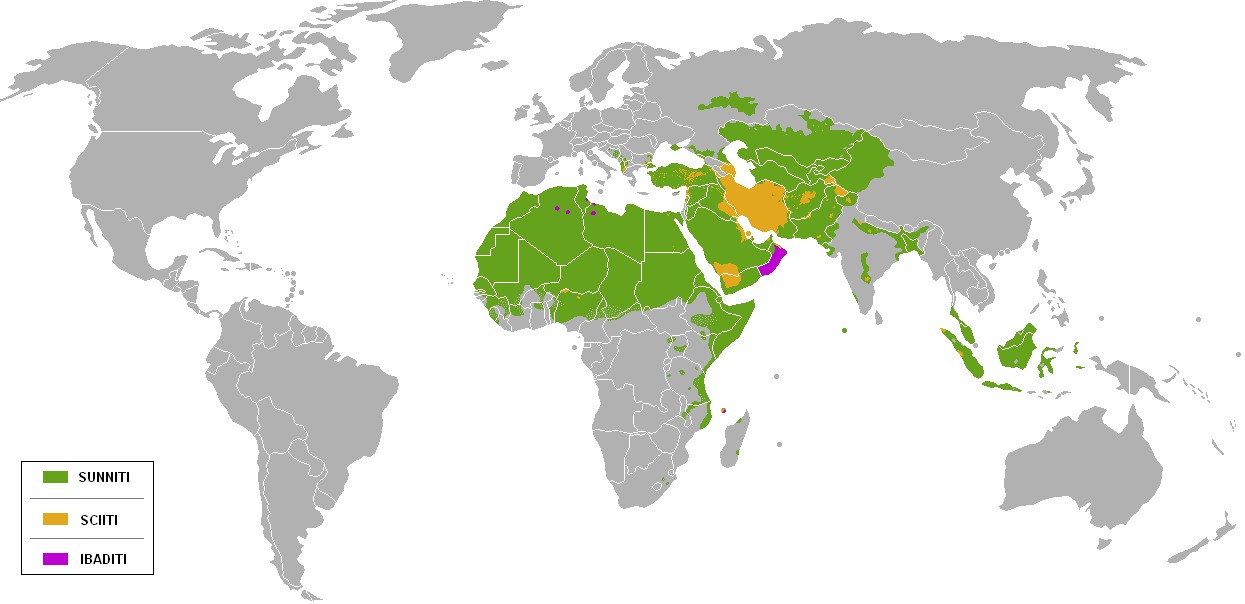
According to Pew Research Center estimates, roughly 87–90 percent of the world's Muslims are Sunni and 10–13 percent are Shia, which puts the number of Shia at about 154–200 million people worldwide. Countries where Shias form a majority include Iran (about 93 percent of Muslims are Shia), Azerbaijan (~65–75 percent), Bahrain, and Iraq (~65–70 percent). Sunnis predominate in the most populous Muslim countries such as Egypt, Indonesia, Bangladesh, and Pakistan, as well as across most of the Arab world, Turkey, North Africa, and South Asia (Source: Pew Research Center — Sunni and Shia Muslims; Pew Research Center — Mapping the Global Muslim Population).
Uzbekistan and Central Asia: mainly Sunni, Hanafi
A large share of the population of Uzbekistan, and of Central Asia generally, is Muslim, and most belong to Sunni Islam and specifically to the Hanafi school. Hanafism has been established in the region since Islam arrived in the 8th century CE and forms the main layer of local religious tradition; it is known for a relatively flexible approach that allows personal reasoning (ra'y). Shia communities also exist in the region — for example, some communities that have long lived in Samarkand and Bukhara — but they form a small minority. Sufism, which here is Sunni, also plays an important role in Central Asian Islam (Source: Britannica — Uzbekistan; Wikipedia — Islam in Uzbekistan).
