BRICS Adopts New Delhi Declaration: 140 Paragraphs on UN Reform and AI Governance
The 18th BRICS summit was held Sept. 12–13 under India's chairmanship. The declaration addressed tensions in the Middle East, reform of the UN Security Council, unilateral sanctions and settlements in national currencies.
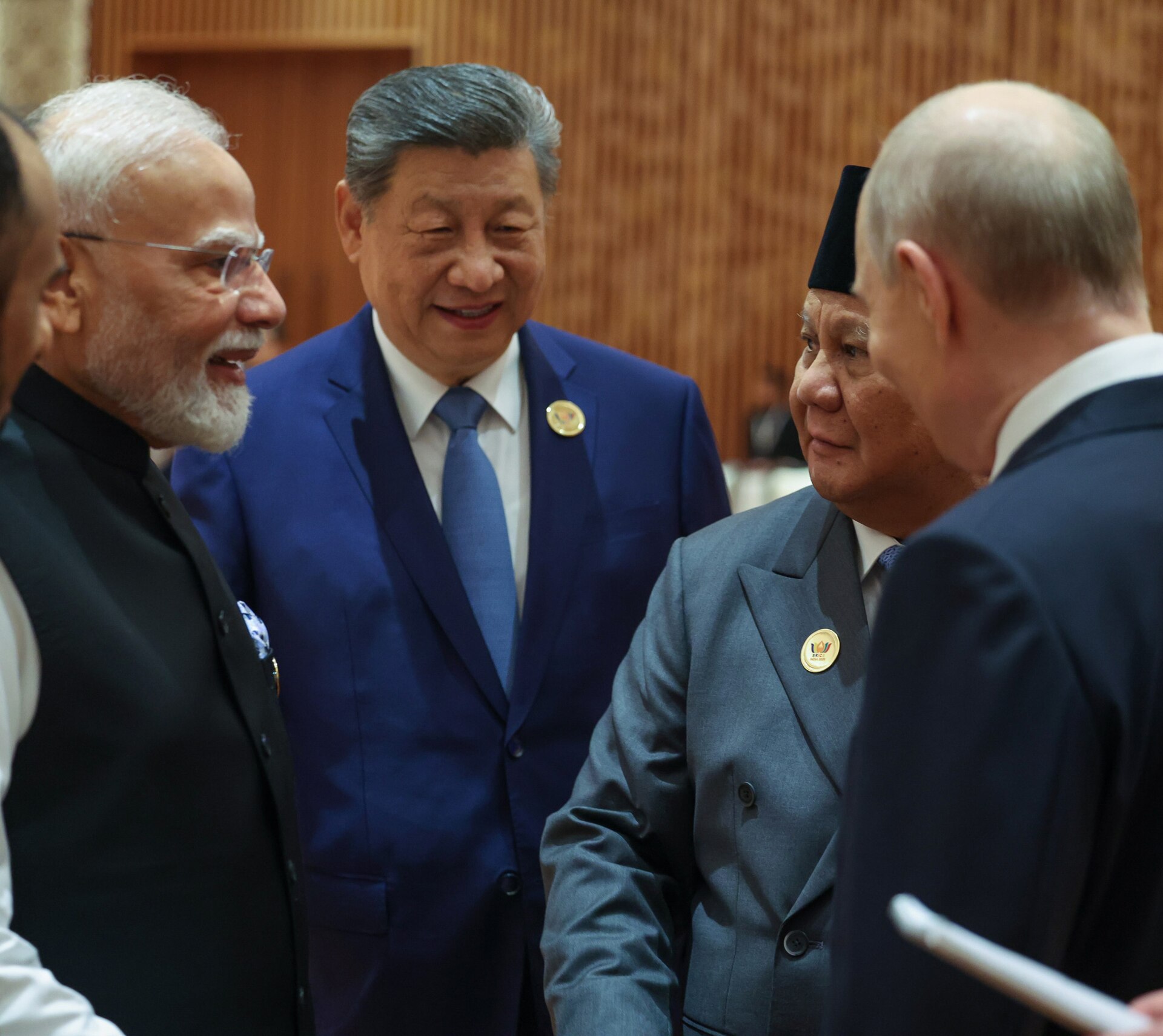
The 18th BRICS summit was held on Sept. 12–13, 2026, at the Bharat Mandapam center in New Delhi. Held under India's chairmanship, the summit's theme was “Building for Resilience, Innovation, Cooperation and Sustainability.”
At the summit's close, the New Delhi Declaration, consisting of 140 paragraphs, was adopted by consensus.
Participants
Representatives of Brazil, China, Egypt, Ethiopia, India, Indonesia, Iran, Russia, South Africa and the United Arab Emirates took part in the summit. The group's countries account for roughly 50 percent of the world's population, 40 percent of global GDP and 26 percent of world trade.
A number of heads of state were invited to the summit as guests. Among them was Kazakh President Kassym-Jomart Tokayev, who held meetings on the sidelines with U.S. Special Envoy Sergio Gor and Indian Prime Minister Narendra Modi.
By the numbers
- Summit dates: Sept. 12–13, 2026
- Venue: Bharat Mandapam, New Delhi
- Summit number: 18th
- Declaration length: 140 paragraphs
- Share of world population: ~50%
- Share of global GDP: ~40%
- Share of world trade: ~26%
- Next summit: 2027, China
The Middle East
In the declaration, the group expressed “deep concern at the continuing escalation of tensions in West Asia.” No specific countries are named in the text; the document calls for maximum restraint and the protection of civilians.
A separate paragraph on Gaza noted that violence has continued despite the ceasefire agreement signed in October 2025. The declaration expressed support for Palestinian membership in the UN and for a two-state solution.
Reform of the UN and international institutions
The document raised the issue of reforming the UN Security Council. The text supported a greater role for Brazil and India at the UN, including on the Security Council; the permanent-member status of China and Russia was noted.
The demand to begin the 16th General Review of quotas at the International Monetary Fund and the World Bank “without further delay” was repeated. The question of redistributing voting rights in favor of developing economies was also noted.
The document placed particular emphasis on the demand to restore the World Trade Organization's dispute settlement system — a fully functioning two-tier binding mechanism.
Sanctions and trade
The declaration set out a position against unilateral sanctions and “carbon border adjustment mechanisms.” No specific countries are named.
The BRICS Payments Task Force will continue to develop trade settlements and investment in national currencies. At the same time, the document carries the caveat that there is “no one-size-fits-all approach” — that is, differing positions on the currency question persist within the group.
Artificial intelligence
AI governance was formally added to the BRICS agenda at the summit. The leaders committed to implementing the BRICS statement on the global governance of artificial intelligence.
Artificial intelligence has thereby become one of the group's principal areas of cooperation, alongside trade and finance.
Terrorism and conflicts
The declaration condemned “in the strongest terms” the 2025 attack in Pahalgam that claimed 26 lives. The text set out a principle of “zero tolerance” for terrorism — regardless of its cause, timing or perpetrator.
The document referenced the situations in Sudan, Syria and Lebanon. The Russia–Ukraine war was not named separately; the text used only the phrase “conflicts in many parts of the world.”
Energy and minerals
The declaration stated the need for critical mineral supply chains to be “reliable, responsible, diversified, resilient, fair and sustainable.”
This issue bears directly on Central Asia: the region holds reserves of uranium, chromite, titanium and rare earth elements, and in recent years has signed agreements in this area with the United States, the European Union, China and South Korea.
Context
What BRICS is and how it expanded
The BRIC acronym was first used in 2001 by the investment banker Jim O'Neill to designate four large, fast-growing economies — Brazil, Russia, India and China. These countries began meeting as an informal political format in 2006 and held their first summit in 2009. South Africa joined the group in 2010, and the acronym took the form BRICS.
The group has expanded further in recent years: Iran, Egypt, Ethiopia and the United Arab Emirates were admitted, and Indonesia later became a member as well. As a result of the expansion, the share of oil-exporting states within the group rose and its geographic reach extended to the Middle East and Africa.
The group's own financial institution, the New Development Bank, was launched in Shanghai in 2015. The bank finances infrastructure and sustainable development projects in member states and developing countries.
The position on de-dollarization
The question of settlements in national currencies has been on the BRICS agenda for several years. The declaration noted that the Payments Task Force will continue to develop trade and investment settlements in member states' currencies.
At the same time, the text carries the caveat that there is “no one-size-fits-all approach.” This indicates the absence of unanimity within the group on the idea of creating a common currency. Indian and Brazilian officials have said on several occasions that a single BRICS currency is not on the agenda.
Central Asia and BRICS
None of the Central Asian states is a BRICS member. Kazakhstan and Uzbekistan have engaged with the group in various formats, but no official decision on membership has been announced.
Kazakh President Kassym-Jomart Tokayev attended the summit as a guest. His schedule in New Delhi included bilateral meetings with U.S. Special Envoy Sergio Gor and Indian Prime Minister Narendra Modi.
The declaration's paragraph on critical minerals bears directly on the region. Kazakhstan holds reserves of uranium, chromite, titanium and beryllium; Uzbekistan ranks fifth in the world in uranium production and has announced a $4.2 billion critical minerals program for 2026–2030.
What the declaration leaves out
The Russia–Ukraine war is not named separately in the 140-paragraph document. The text uses only the phrase “conflicts in many parts of the world.” International publications noted this as an indication of the difficulty of reaching consensus within the group given Russia's membership.
The paragraph on the Middle East likewise names no specific countries: the text uses the phrase “continuing escalation of tensions in West Asia.” Although Iran is a member of the group, neither the United States nor Israel is mentioned directly in the document.
No countries are named in the paragraph opposing unilateral sanctions either. The same approach applies to the paragraph on “carbon border adjustment mechanisms” — a mechanism introduced by the European Union, though the text does not name it.
Organizational aspects of the summit
The summit was held at Bharat Mandapam, a conference center on the grounds of Pragati Maidan in New Delhi. The center also hosted the G20 summit under India's chairmanship in 2023.
Preparations for the summit were completed on Sept. 11. The leaders' session began on Sept. 12, and the declaration was adopted that day; additional sessions and bilateral meetings were held on Sept. 13.
The next summit, the 19th, will be held in China in 2027.
BRICS took shape as an informal format in 2006 and held its first summit in 2009. The group has expanded in recent years, with Iran, Egypt, Ethiopia, the United Arab Emirates and Indonesia joining.
The next summit will be held in China in 2027.