Freight Along the Middle Corridor Rose 22 Percent, but Eastbound Cargo Lags
In January–August 2026, the westbound direction accounted for 80 percent of container flows on the Trans-Caspian route. Only 20 percent moved east.
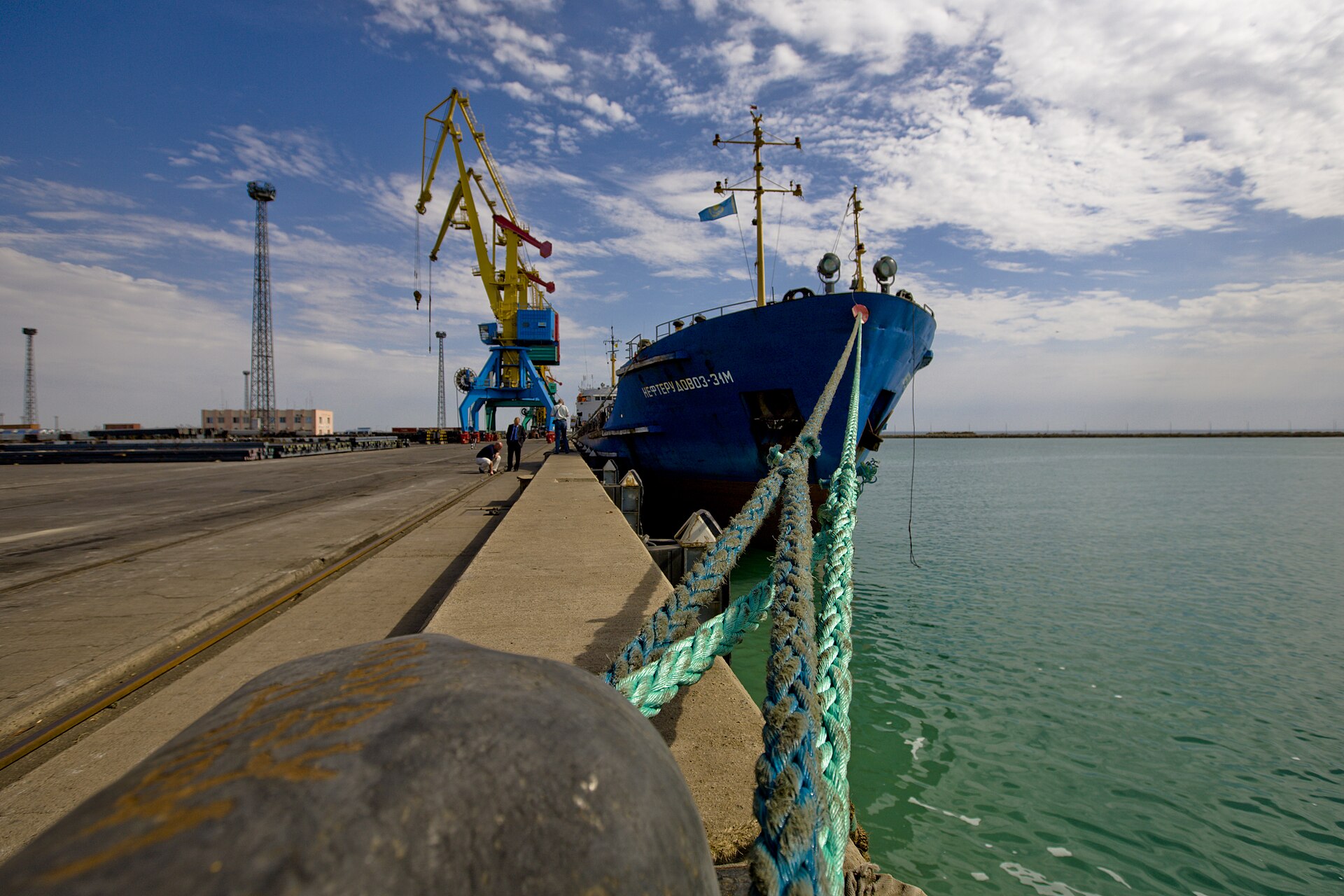
Freight volumes along the Trans-Caspian International Transport Route — the corridor often called the “Middle Corridor” — rose 22 percent in the first eight months of 2026. Transit in the East–West direction increased 55 percent.
At the same time, a significant imbalance persists in the statistics: roughly 80 percent of container flows move west and only 20 percent east. From January to August, 42,642 TEU were carried from east to west and 10,932 TEU in the opposite direction.
What the Middle Corridor is
The Middle Corridor is a multimodal route running from China through Kazakhstan, the Caspian Sea, Azerbaijan and Georgia to Turkey and Europe. It is regarded as an alternative to the northern route through Russian territory.
The route's defining feature is that it consists of land, sea and land segments again. Cargo is transferred to a ferry on the Caspian Sea and then back to rail. Every transshipment means additional time and cost.
Seven-year trend
Freight volumes carried along the Middle Corridor through Kazakhstan have risen more than fivefold over the past seven years: from 0.8 million tons a year to 4.5 million tons.
- Containers carried in 2025: ~77,000 TEU
- Forecast for 2029: 300,000 TEU
- January–August 2026: freight volume +22%
- East–West transit: +55%
- Share of eastbound containers: ~20%
Why empty containers are a problem
A one-directional cargo flow is a classic problem in logistics. A train that travels west with full containers often returns east empty. This raises the unit cost per TEU, because the return leg generates no revenue.
In practice, this makes it harder to keep the route's tariffs competitive with the sea route through the Suez Canal. Sea transport is slower but cheaper per unit of cargo.
Infrastructure investment
In early 2026, the World Bank approved an $846 million guarantee for the Kazakh rail operator Kazakhstan Temir Zholy; it supports $1.4 billion in financing. The Asian Infrastructure Investment Bank also joined the project.
The funds are tied to operational reforms: the main focus is on improving the efficiency of the Caspian ports of Aktau and Kuryk.
The 2026 work plan
The countries participating in the route approved a detailed work plan for 2026. The plan's main thrust is digitalizing transport processes: moving document flows to electronic form, speeding up data exchange at borders and integrating cargo tracking systems.
Constraints
Analysts note that the route's capacity is limited: the size of the fleet on the Caspian Sea, the throughput of the ports and the capacity of rail sections are the principal bottlenecks.
In terms of overall volume, moreover, the Middle Corridor accounts for a small share of China–Europe trade. Its role is seen mainly as an alternative route — that is, as a backup when disruptions occur on other routes.
Another route for Kazakhstan
Over the same period, Kazakhstan is also considering alternative routes for its oil exports. The Caspian Pipeline Consortium (CPC) carries more than 80 percent of the country's oil exports; loading at the terminal near Novorossiysk was briefly halted on Sept. 8.
The route's geography
The Middle Corridor begins at China's western border. Cargo is carried by Kazakhstan's railways to the ports of Aktau or Kuryk on the Caspian coast, and from there transferred by ferry or dry cargo vessel to Azerbaijan's port of Baku (Alat).
In the next stage, cargo is sent through Georgia to Black Sea ports or to Turkey via the Baku–Tbilisi–Kars railway. The end point is the European markets.
The route changes mode at least twice: from rail to sea and from sea back to rail. Each transfer requires additional time, crane and terminal work, and document processing.
A comparison with alternative routes
There are three main options for carrying freight between China and Europe. The first is the sea route through the Suez Canal; it is the cheapest but takes 30 to 45 days. The second is the northern rail route through Russia and Belarus. The third is the Middle Corridor.
The Middle Corridor's advantage is the distribution of political risk and a shorter transit time than the sea route. Its drawbacks are the number of transshipments and the limited capacity of the infrastructure.
Since 2023, because of the security situation in the Red Sea, some carriers have chosen the route around southern Africa instead of the Suez Canal; this has been one of the factors increasing interest in land corridors.
Ports and fleet
The size of the fleet on the Caspian Sea is one of the route's main constraints. The number of ferries and container vessels is limited, and their schedules also depend on weather conditions.
The financing program supported by the World Bank is aimed at improving the efficiency of the ports of Aktau and Kuryk. Terminal capacity and loading speed have a direct effect on the throughput of the entire route.
What it means for Uzbekistan
Uzbekistan connects to the Middle Corridor through Kazakhstan and Turkmenistan. For the country, this route is one of the alternative ways to reach European markets.
At the same time, Uzbekistan is also developing the southern route: feasibility studies are under way for the Trans-Afghan railway project, which envisions access to Pakistani ports through Afghanistan.
Digitalization
The 2026 work plan identifies digitalizing transport processes as the main thrust. This includes electronic document flow, advance data exchange at borders and cargo tracking systems.
In practical terms, the main effect of digitalization is seen in reducing waiting times at borders — which in turn has a direct effect on overall delivery times.
Tariffs and transit time
For shippers, the two main criteria in choosing a route are price and transit time. Delivery along the Middle Corridor is generally faster than by sea but more expensive per unit of cargo.
For that reason, the route is mainly attractive for high-value-added goods — electronics, spare parts, chemical products. For heavy, low-value cargo, the sea route remains preferable.
Container balance
The question of returning empty containers affects the economics of the entire corridor. Operators generally use three approaches to address it: discounted tariffs for the return leg, developing a cargo base in the region, and redistributing containers to other routes.
Because raw materials make up a high share of Central Asian states' export structure, the volume of containerized cargo is limited — another reason for the imbalance.
According to Kazakhstan's Ministry of Energy, 64.8 million tons of oil were exported through the CPC in 2025, while roughly 1.2 million tons a year are shipped through the Baku–Tbilisi–Ceyhan pipeline.