The Uzbek Diaspora in Kazakhstan: How the Southern Community Took Shape
A fact-based article on the historical formation of the Uzbek community living in southern Kazakhstan — the Turkistan Region, Shymkent and along the Syr Darya. It traces the period from the Kokand Khanate through the drawing of Soviet state borders to the present-day population in independent Kazakhstan, with dates and figures. Verified facts only.
The Uzbeks of Kazakhstan are one of the country's largest ethnic minorities, living mainly in the south, in areas bordering Uzbekistan. This community is no accident: it is the product of a settled culture formed over centuries and of the drawing of state borders in the 20th century.
The historical roots of a settled culture
Southern Kazakhstan — the Syr Darya basin, Shymkent (Chimkent) and the area around Turkistan — has historically been tied to Central Asia's settled tradition of farming and town life. In the region the nomadic Kazakh way of life existed alongside the settled Uzbek/Sart population. Before the Russian conquest these lands were part of the Kokand Khanate; Tashkent was taken by Russia in 1865, and the Kokand Khanate was abolished and absorbed into Russia in 1876.
The city of Turkistan and the Mausoleum of Khoja Ahmed Yasawi
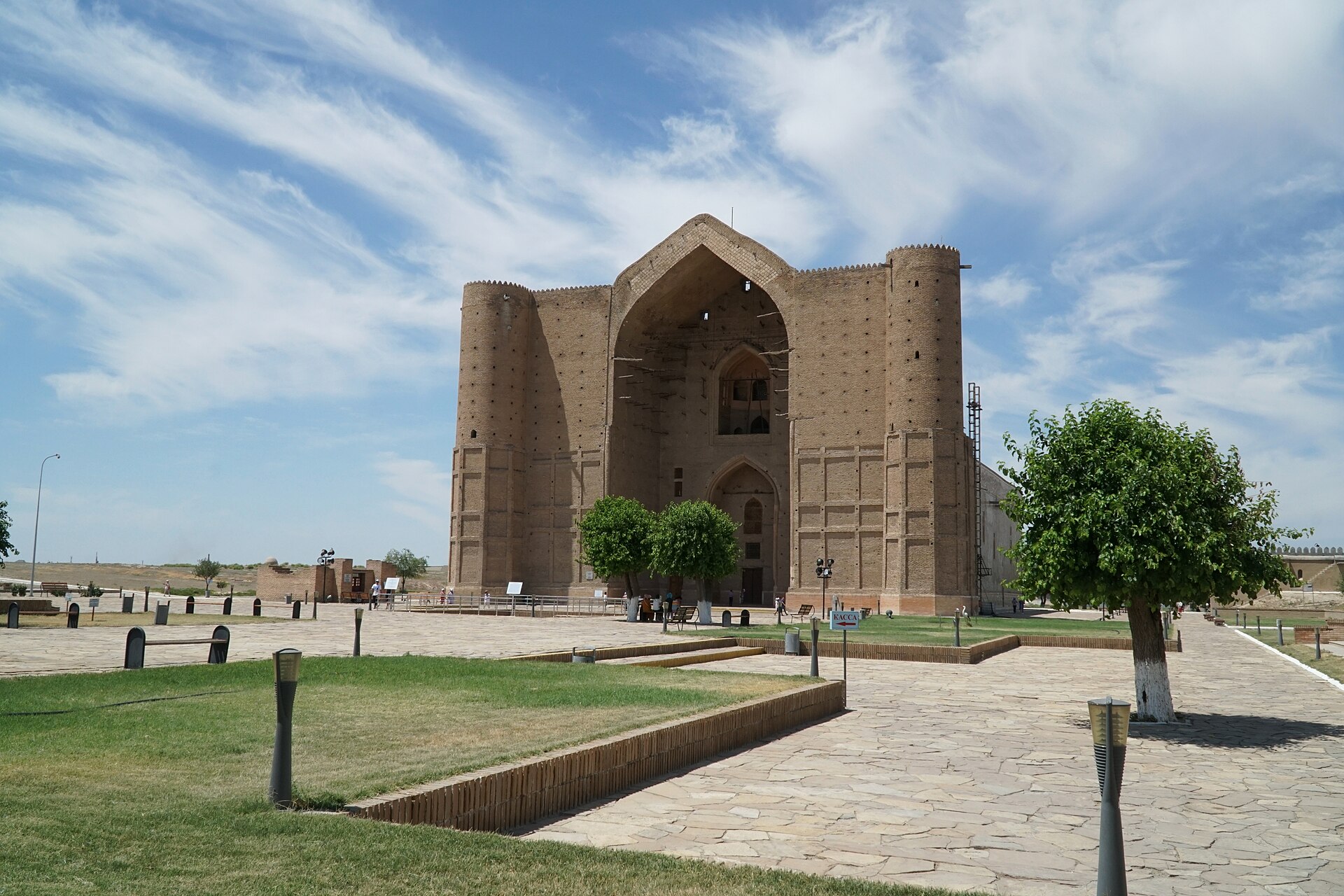
The city of Turkistan (ancient Yasi) in southern Kazakhstan is a symbol of shared Timurid and Uzbek heritage. The Mausoleum of Khoja Ahmed Yasawi was begun in 1389 on the order of Amir Temur (Tamerlane), but construction stopped in 1405 with Temur's death and the building was left unfinished. It was built to honour the 12th-century Sufi master Khoja Ahmed Yasawi (1093–1166). Standing about 38.7 metres tall, the mausoleum is one of the largest and best-preserved examples of Timurid architecture and served as a model for the style later used in Samarkand. In 2003 it became Kazakhstan's first UNESCO World Heritage Site.

1924–1936: the Soviet national-territorial delimitation
The decision to carry out the national-territorial delimitation of Central Asia was taken on 12 June 1924 and formalized in law on 24 October 1924. Because the borders were drawn through populations that had long lived intermingled, the compact, settled Uzbek-populated areas around Shymkent and Turkistan ended up within the Kazakh administrative entity — and so a cross-border Uzbek minority came into being. The Kazakh ASSR took shape in 1925; in 1932 the South Kazakhstan Oblast, with Chimkent as its centre, was created; and on 5 December 1936 Kazakhstan was elevated to a full union republic (the Kazakh SSR).
The Soviet period
During the Soviet period the Uzbeks of southern Kazakhstan remained a largely settled minority engaged in farming and town life, concentrated in the Chimkent region and the adjacent Dzhambul region. Ancient Uzbek towns such as Sayram — one of Kazakhstan's oldest settlements — show the continuity of this settled tradition.
In independent Kazakhstan: by the numbers
According to Kazakhstan's censuses, the Uzbek population grew steadily: 370,663 in 1999 (2.48% of the population); 456,997 in 2009 (about 2.86%) — overtaking Ukrainians to become the country's third-largest ethnic group; and 614,047 in 2021 (3.20%). The community is concentrated mainly in the south — in the Turkistan Region (so named in 2018; bordering Uzbekistan) and the city of Shymkent, as well as the Saryagash and Sayram districts.
Language, identity and cross-border ties
The Uzbeks of Kazakhstan share the same Uzbek language and culture as Uzbekistan. The eastern part of the Kazakhstan–Uzbekistan border is densely settled, with major towns and villages on both sides; this keeps cross-border family, trade and cultural ties strong. The region's Uzbek identity is historically rooted in the settled, urban tradition — in long-established towns such as Sayram.
Note: this article sets out historical and demographic facts. The population figures rely on official censuses; changes between years reflect the census dates.
