The Turkestan Legion and postwar emigration (1941–1945): from captivity to the Western diaspora
In World War II, Nazi Germany formed the "Turkestan Legion" from Soviet prisoners of war — Uzbeks, Kazakhs, Turkmens, Kyrgyz and Tajiks. For most it was not ideology but a forced choice to survive starvation. This neutral history, on the basis of sources and verified facts only, recounts the legion's formation, the roles of Veli Kayum Khan and Mustafa Chokay, and how survivors became part of the Western diaspora.
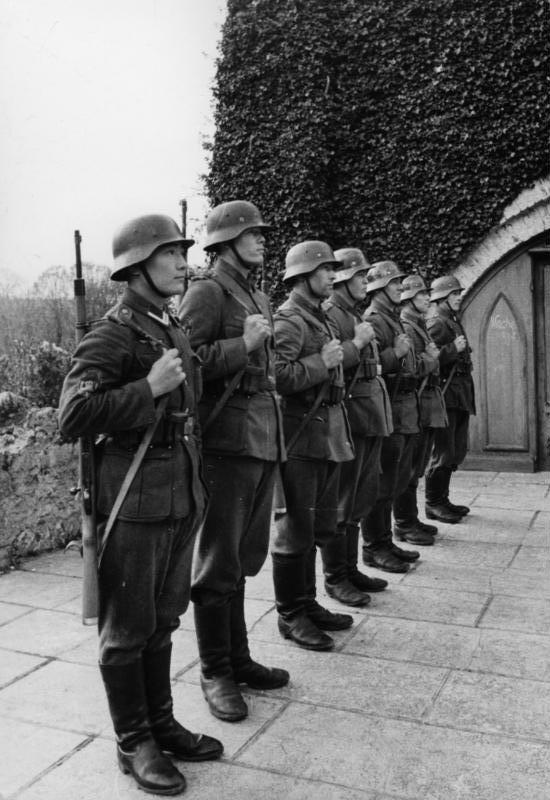
In autumn 1941, after Germany's invasion of the USSR stalled, the Nazis reversed their initial "racially inferior" view of Turkic peoples and decided to exploit anti-Soviet sentiment. In October 1941 the Wehrmacht began separating out Turkestanis in POW camps through special commissions, and within the "Eastern Legions" (Ostlegionen) the Turkestan Legion and the Caucasian-Muslim Legion were formally founded on 13 January 1942. (Source: Wikipedia — Turkestan Legion; Wehrmacht foreign volunteers and conscripts.)
Who it was made of
The legion's members were mainly Central Asian peoples captured in the ranks of the Red Army: Uzbeks, Turkmens, Kazakhs, Kyrgyz, Tajiks and others. That is, it was not a voluntary ideological movement but a Wehrmacht unit formed from Soviet prisoners of war. The legion was committed to combat in May 1942 and by 1943 had expanded to about 16 battalions and roughly 16,000 soldiers. (Source: Wikipedia — Turkestan Legion; Ostlegionen.)
How many people?
Over the whole war, the total number of Turkestanis who passed through the "Eastern Legions" is estimated differently by different sources — roughly 110,000 to 180,000 (one academic estimate says about 180,000 by 1944). This is a cumulative total, distinct from the roughly 16,000 strength of the legion itself in 1943; the exact figure varies considerably between sources. (Source: Wikipedia — Wehrmacht foreign volunteers and conscripts.)

Starvation: a forced choice
For most, joining the legion was not ideology but a means of surviving starvation and death — this should be stated neutrally. The death rate in German POW camps was catastrophic: by some accounts about 80% of roughly 100,000 Turkestani prisoners died in the first winter (1941–42). At the Częstochowa camp, of about 32,000 Turkestanis held in autumn 1941, only 262 are reported to have been alive by spring 1942. (Source: Qalam Global — Kazakhs and "Turkestanis" in German Captivity.)
Veli Kayum Khan and the National Turkestan Unity Committee
The legion's political wing was led by Veli Kayum Khan, an émigré politician born in Tashkent on 15 July 1904 who had studied in Berlin from 1921. He chaired the National Turkestan Unity Committee (Nationales Turkestanisches Einheitskomitee), which functioned as a Turkestan "government" in exile; he oversaw Berlin propaganda and the training of prisoners. After the war Kayum Khan lived stateless in West Germany and died in Düsseldorf on 13 August 1993. (Source: German Wikipedia — Veli Kajum-chan.)
Mustafa Chokay: offered the role, but refused
Mustafa Chokay (Mustafo Cho'qay), former head of the Turkestan (Kokand) Autonomy and an émigré statesman, was also offered leadership of the legion. After Germany invaded the USSR (22 June 1941) the Nazis arrested him in occupied France and brought him to Berlin. Having toured the POW camps and seen the conditions, Chokay refused further cooperation. Born on 25 December 1890, he died in Berlin on 27 December 1941; the official cause was blood poisoning amid a typhus epidemic, but some sources (including the memoir of his wife Maria) suspect poisoning — a question that remains unresolved. After his death, leadership of the political committee passed to Veli Kayum Khan. (Source: Wikipedia — Mustafa Shokay; e-history.kz.)
After the war: forced repatriation
In 1945 most legionnaires were captured by the Western Allies. Under the Yalta agreements signed on 11 February 1945, Soviet citizens — including Wehrmacht "Eastern Legion" personnel — were to be forcibly repatriated to the USSR; returnees faced execution or the Gulag as "traitors." The process was mass-scale and often violent: by the end of September 1945 about 2,034,000 Soviet citizens had been returned from the Western zones. (Source: Wikipedia — Repatriation of Soviet citizens after World War II; Turkestan Legion.)
The formation of the Western diaspora
Turkestanis who escaped forced repatriation formed émigré communities in West Germany (Munich, Cologne) and in Turkey. Veli Kayum Khan served a short prison term and then lived out his life stateless in West Germany. Baymirza Hayit (born 17 December 1917 in Namangan; died 31 October 2006 in Cologne), a legion officer, became a noted Turkologist at the University of Münster (doctorate 1950), wrote a series of books on Turkestan's history, and became an important voice of the émigré community. (Source: Wikipedia — Baymirza Hayit; German Wikipedia — Veli Kajum-chan.)
Conclusion
The history of the Turkestan Legion is not a story of victory or heroism but a tragedy of war, captivity and forced choices. It was at once an attempt to survive starvation and a part of Turkestan's political emigration in exile; and in the end — through those who survived the Yalta repatriations — it shaped the Uzbek-Turkestani diaspora in the West. Some details, such as certain figures and the cause of Chokay's death, are disputed among sources and are presented here with caution and without one-sided judgment.

Sources
- Wikipedia — Turkestan Legion
- Wikipedia — Wehrmacht foreign volunteers and conscripts
- Wikipedia — Mustafa Shokay
- e-history.kz (Kazakhstan national digital history) — Mustafa Shokay
- Qalam Global — Kazakhs and "Turkestanis" in German Captivity
- Wikipedia — Repatriation of Soviet citizens after World War II
- Wikipedia — Baymirza Hayit
- German Wikipedia — Veli Kajum-chan